

The graduate student team from SDJU Ultra-Wide-Bandgap (UWBG) Semiconductor Lab recently achieved outstanding results in 2026 Mechanical Engineering Innovation and Creativity Competition (MEICC). Competing in the Failure Analysis Competition and the Materials Heat Treatment Innovation and Entrepreneurship Competition, the team won one national first prize and one excellence award, as well as two second prizes and one third prize at the regional level. These achievements demonstrate the team’s solid professional foundation and strong capacity for innovation and practical application.
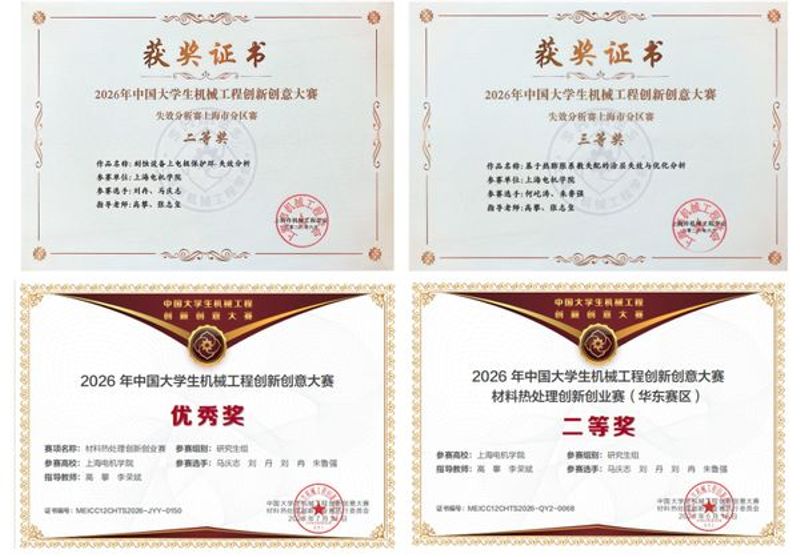
At the 2026 MEICC OPTON Cup 11th Failure Analysis Competition, Liu Ran and Ma Qingzhi presented a project titled “Failure Analysis of the Upper Electrode Protection Ring in Etching Equipment”. After winning second prize in the Shanghai regional competition and advancing to the national competition, they ultimately secured a national first prize. He Yitao and Zhu Luqiang received third prize in the Shanghai regional competition for their project – “Analysis and Optimization of Coating Failure Based on Coefficient of Thermal Expansion Mismatch”.
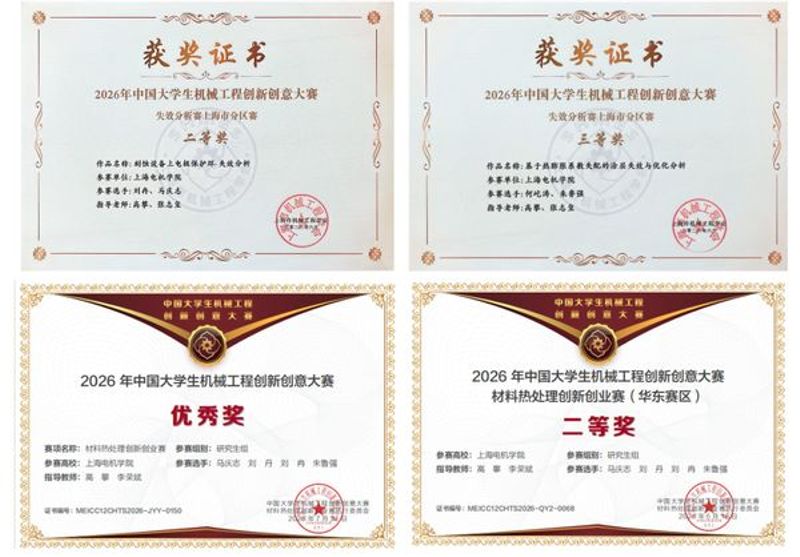
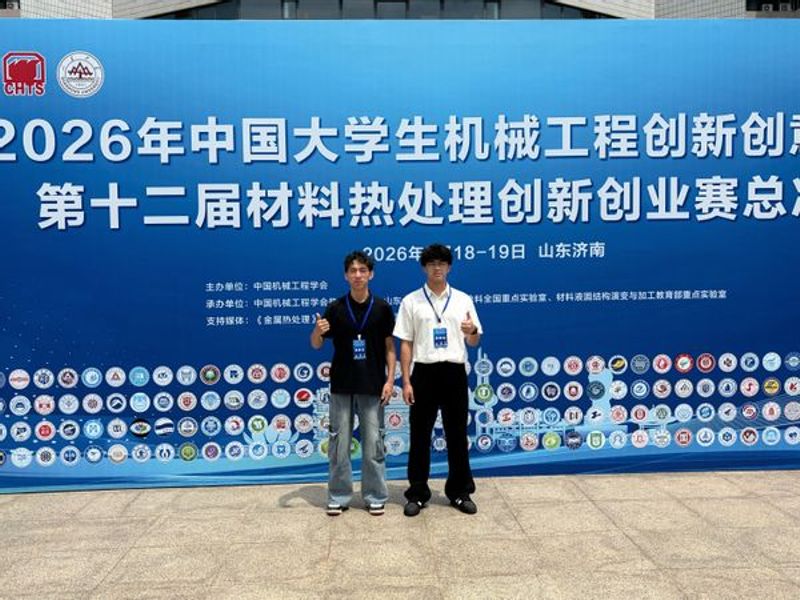
In the Materials Heat Treatment Innovation and Entrepreneurship Competition, the graduate student team comprising Ma Qingzhi, Liu Dan, Liu Ran, and Zhu Luqiang won second prize in the East China regional competition and subsequently received an excellence award in the national final.
Addressing national needs for self-reliance and controllability in the semiconductor sector, new-energy power devices, and high-end equipment, the participating teams have focused on wide-bandgap semiconductor materials, PVT crystal growth, and failure analysis of coatings and critical components. They have continued to conduct research into crystal-growth stress and impurity control, coating failure mechanisms, and the reliability of critical components in semiconductor equipment. These awards represent a significant milestone in the laboratory’s efforts to promote learning and research through competition. Looking ahead, the lab teams will continue to respond to practical industrial needs and advance the deep integration of scientific research and innovation with engineering practice.