
The 11th China (Shanghai) International Technology Fair (CSITF), themed “Open Collaboration: Empowering New Quality Productive Forces and Sustainable Development,” was held at the Shanghai World Expo Exhibition & Convention Center from June 11 to 13. Our university exhibited six high-tech achievements in fields of intelligent manufacturing, artificial intelligence, and new energy, demonstrating our innovative strength in key technology R&D and industrial applications.
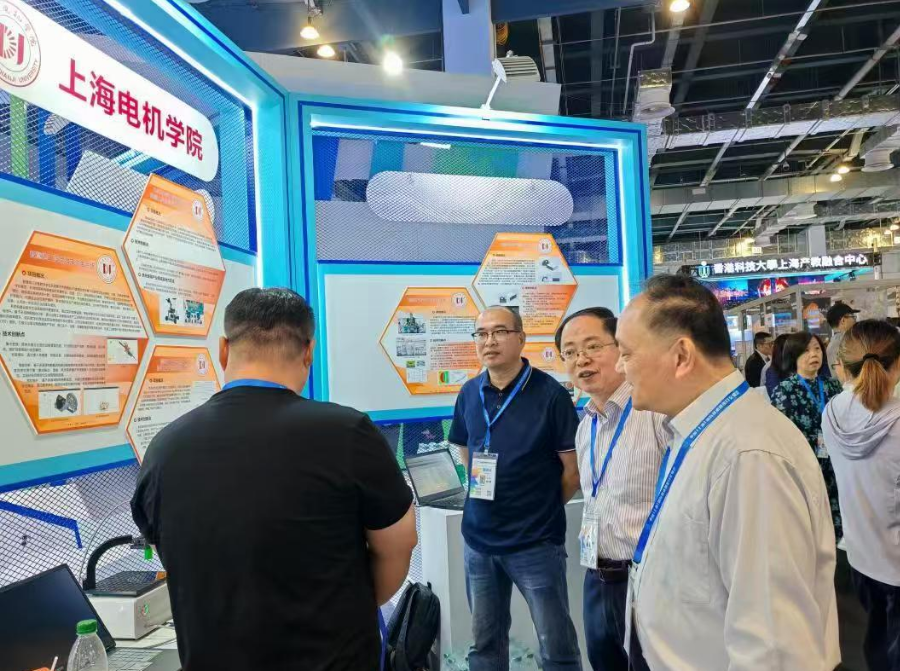
During the exhibition, Deputy Director Jiang Hao and Deputy Director Zhang Yan from Science and Technology Development Center of Shanghai Municipal Education Commission attentively listened to the introduction of our university’s exhibited projects, with a particular focus on inquiring about intellectual property protection, industry-university-research cooperation models, and market application scenarios. Deputy Director Jiang noted that these exhibited projects closely aligned with national strategic needs, demonstrating significant industrial empowerment value through technological breakthroughs in areas such as intelligent equipment and green energy, and he expressed expectations for more achievements to achieve transformation and practical implementation via the platform of CSITF.
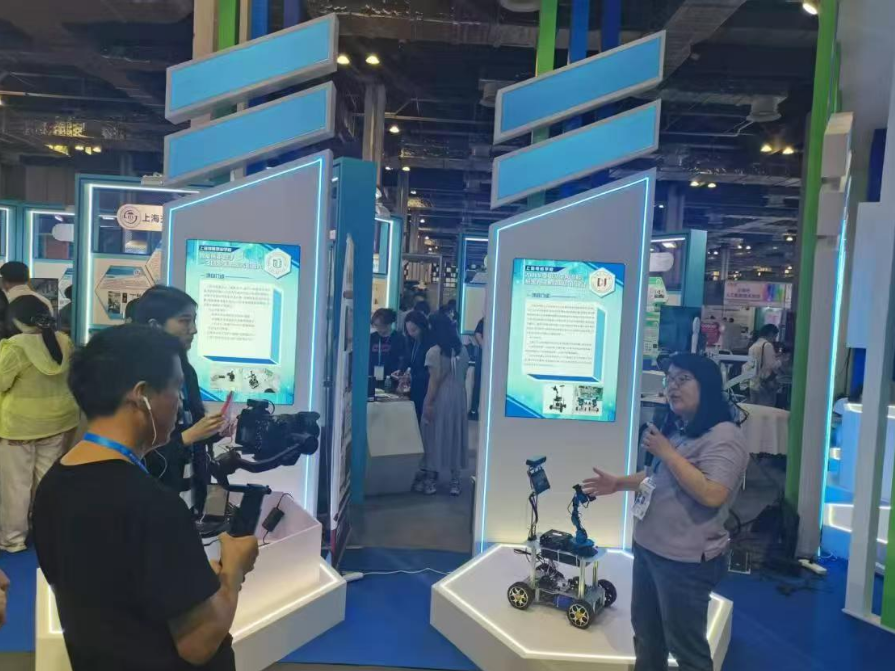
The Multi-Robot Collaborative Optimization Design for 220kV Substation Indoor Inspection, developed by Professor Zhang Wei’s team from School of Electrical Engineering (SEE), became a focal point during the exhibition’s Robot Show. This technology overcomes the limitations of traditional inspection robots, which rely on magnetic track positioning and have weak obstacle avoidance capabilities, enabling precise detection of equipment appearance anomalies and isolator switch statuses. During the live demonstration, the robots efficiently completed multi-machine collaborative inspection tasks in a simulated substation, earning high praise for their intelligent and automated performance from industry experts and exhibitors.
Professor Ning Yinhang’s team from SEE presented the Design of Zero Rare-Earth Synchronous Reluctance Motor and its Controller Development project in Inno-Show demo. Its high cost-effectiveness and energy-saving features attracted interest for cooperation from enterprises in the new energy vehicle and industrial drive sectors, highlighting its broad application prospects under high-temperature and high-speed conditions.
Other exhibited projects also featured distinct industrial application characteristics: The Smart Energy Pipeline Network Safety Monitoring System by Professor Shi Jian’s team from School of Electronics and Information Engineering (SEIE) is being piloted in long-distance pipeline scenarios. The Digital Twin System for Smart Port Equipment by Professor Hao Jutao’s team from SEIE enables equipment health status assessment and remaining life prediction. The Reflective Full-spectrum Film Thickness Gauge by Professor Li Zhisong’s team from School of Mechanical Engineering (SME) is suitable for high-precision detection in fields such as semiconductor and photovoltaics. The High-temperature Superconducting Magnet Manufacturing Technology by Professor Zhang Qianjun’s team from the School of Materials Science and Engineering (SMSE) has been successfully applied to the world’s first all-high-temperature superconducting Tokamak device HH70, providing core component support for controlled nuclear fusion and high-field equipment.
Additionally, the Intelligent Preparation Process for Single-Crystal Turbine Blades by the team led by Zeng Lingyan from our university, together with Shanghai Jiao Tong University’s Additively Manufactured Micro Gas Turbine Regenerator and Shanghai University’s Integrated Inspection and Form Control Technology for Blade Manufacturing Process, were showcased jointly at the heavy-duty gas turbine exhibition area. All these projects are oriented toward the development needs of the heavy-duty gas turbine industry, carried out in collaboration with China United Gas Turbine Technology Co. Ltd. (UGTC) under the Joint Innovation Program, demonstrating the significant advantages of university–enterprise collaboration.
During CSITF of this year, SDJU projects garnered extensive attention from research institutions, manufacturing enterprises, and investment firms, with several projects reaching preliminary cooperation intentions with technology demanders. SDJU will leverage this fair to continually deepen the collaborative innovation mechanism of production, education, research, and application, pushing more core technologies from the lab to the industrial frontline, and contributing SDJU wisdom to high-quality regional economic development and technological self-reliance.